
Global religious landscape set for a major demographic shift as faster Muslim population growth narrows the gap with Christianity
The world’s religious landscape could witness a historic shift within the next decade, with the Muslim population projected to surpass the Christian population around 2035, according to the latest projections by the Pew Research Center.
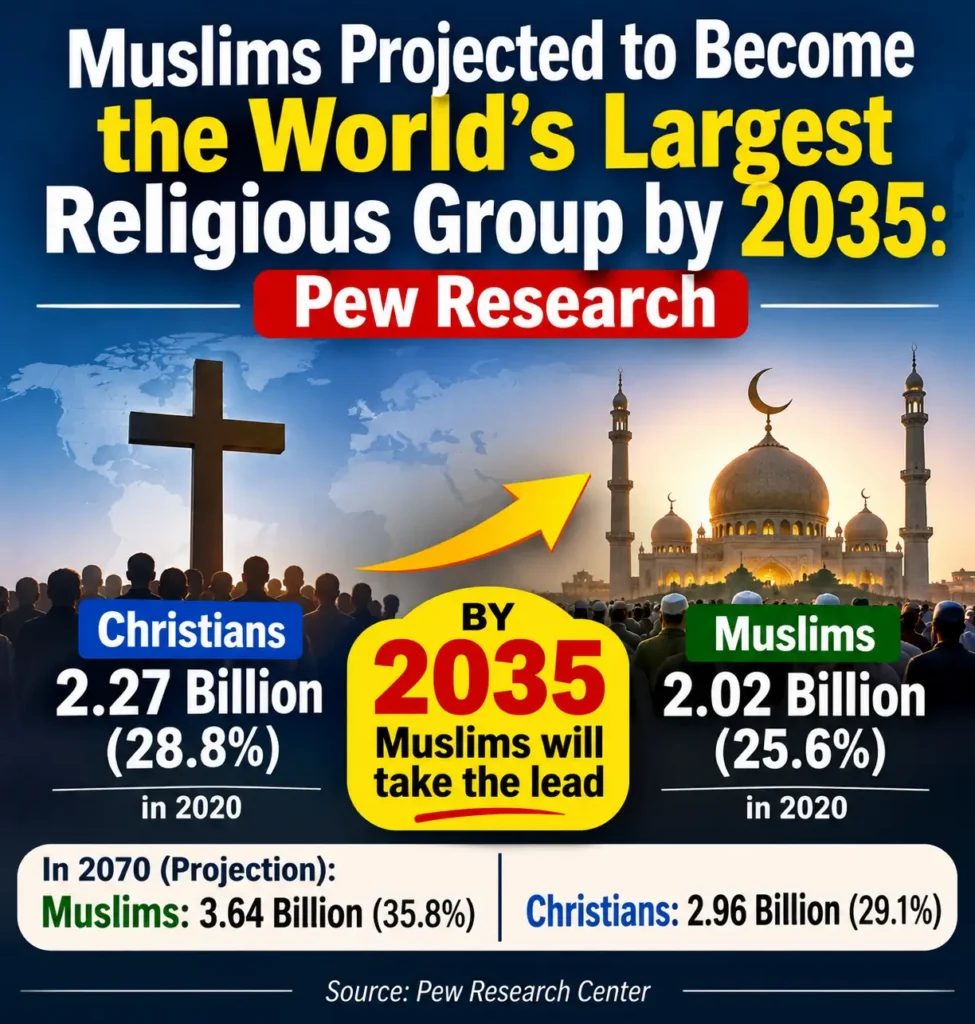
Pew estimates that in 2020, Christians numbered approximately 2.27 billion, accounting for 28.8% of the world’s population. Muslims numbered around 2.02 billion, or 25.6% of the global population.
The gap is expected to narrow rapidly because the global Muslim population has a younger age structure and higher fertility rates than the Christian population. According to Pew, these demographic factors are the principal drivers behind the faster growth of the Muslim population.
Muslims projected to lead by 2035
Pew’s latest projections indicate that Muslims could overtake Christians in total population by approximately 2035.
The trend is expected to become more pronounced in the following decades. By 2070, Pew projects around 3.64 billion Muslims, representing approximately 35.8% of the world’s population.
The Christian population, meanwhile, is projected to reach around 2.96 billion, or approximately 29.1% of the global population.
Growth driven mainly by demographics
The projected shift does not primarily reflect large-scale conversion from Christianity to Islam. Instead, Pew attributes the difference largely to fertility patterns and population age structures.
Muslims globally are younger on average, meaning a larger proportion of the population is entering or is already in their childbearing years. Higher fertility rates in many Muslim-majority countries also contribute to faster population growth.
Christianity, meanwhile, is expected to continue growing in absolute numbers globally, although its share of the world’s population is projected to decline.
A changing global religious map
The demographic shift is likely to be particularly significant in Africa and Asia, where some of the world’s fastest-growing populations are concentrated.
The projections underscore how population growth, fertility, age distribution and mortality can reshape the global religious balance over several decades.
The Pew projections therefore point to a significant milestone: Christianity may remain one of the world’s largest religious communities, but Islam is on course to become the world’s largest religion by the middle of the 2030s.
Daily Quote
More Hyderabad News









Telangana News…
Andhra Pradesh News …



More National, Global News








You can get instant news and articles from Hyderabad Post
Click to Like/Follow/Subscribe us on Facebook – Twitter – Telegram – Instagram – WhatsApp – YouTube